DRAFF
  • HOME
  • ABOUT
  • IN PRINT
  • ON THE ROAD
  • ON FILM
  • OFFCUTS
  • CONVERSATIONS
  • PODCASTS
  • DONATE
  • CONTACT

JOSE MIGUEL JIMENEZ W/

dearbhla walsh / fearghus o conchuir

The Casement Project is a multi-part art piece spanning one year and multiple forms, inquiring into the idea of nationhood and identity through the clouded story of Irish rebel and British knight, Roger Casement. Following a premier in London and a day-long festival on a beach, TCP artistic director Fearghus O'Conchuir and filmmaker Dearbhla Walsh speak to DRAFF's own filmmaker José about adapting a full-length contemporary dance piece from stage to screen.

J: So I guess the first question really is: why adapt a stage show into a film?

F: One reason for doing a film is accessibility – I worked with Dearbhla on Match [a contemporary dance film screened on RTÉ], and on the first night it was screened it was seen by 100,000 people and that’s probably more people than would see my work live over my entire career. It’s been seen all around the world at different festivals - it’s still being seen. So making a film is an important way of sharing the work. The Casement Project [TCP] is about showing up on many different platforms – to show what dance will look like in many different forms, and to let the work be transformed by the forms, to offer lots of different ways into the project.

J: When I spoke to you [Fearghus] in the early days of the project, one of the things that seemed to be important and which I thought was very interesting was the focus on inkblots. In adapting Roger Casement’s diaries into a dance piece, you looked at the inkblots that had transferred from the handwritten text onto the facing page, rather than the text itself. You worked with the traces of the text. How has that worked for you Dearbhla, in terms of adapting a dance piece into a film piece, a piece that was adapted from these inkblots?

D: How I approached the dance is the same way I would approach any dramatic piece or story: it all starts with a script. Fearghus and I have worked together before so there was a huge level of trust when the project was still very much in its creation. It was very clear what the process was going to be, because whatever the film was it was going to be an adaptation of the stage show. I approached the piece in the same way an audience member would, but with my director’s sensibility on. I watched two or three showings of it and just sat and experienced it and it was what I reacted to, narratively, emotionally, intellectually - the things that stuck, the inkblots for me, if you like. Seeing it in a rehearsal space first was really valuable because it was up close and personal. I think I noted to Fearghus at the time that if I’d gone to see the stage show alone, different elements might have stuck with me. So I think the intimacy of the rehearsal and the work in progress aspect of it was hugely influential. I wrote down my reactions, then Fearghus and I compared notes, and we were utterly in sync. There was no disagreement at all. I broke my approach down into themes, and I used quite a different vocabulary to Fearghus, so we had to find a common language. I remember listening to an interview with Emma Donoghue about writing Room and Lenny [Abrahamson] talking about adapting the book and how you can create a story in a small space - it’s effectively the same thing with TCP, though on a beach rather than in a room. Emma broke it down into themes, and we did something similar. I think we created nine scenes. And it was really the process of sharing my experience of the piece. When I read a script first when I’m making a drama, I always remember that very first reading; it’s really important. The thing that made you laugh, cry, that you didn’t understand… because you can never repeat that virgin experience. So on my part it was quite an un-intellectual approach, because Fearghus had already done all the intellectual work.

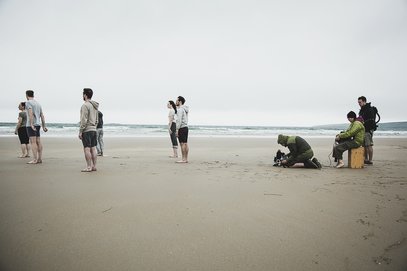
​F: One of the reasons to work with film is that the camera can bring us both almost to the experience of a dancer within the show and an audience member - you can be intimate and inside the work, as well as draw back and be far away, and that’s a thing you can’t achieve in a theatre because once you’re in, you have a space and there’s a frame that’s set up for you. And this ability of film to alternate perspectives is something important that helps me to share the work in a different way. For me, the film was always going to be shot on Banna [Strand - the site of Casement’s landing], on that one canvas, and that’s something that’s shared from the two films Dearbhla and I have made before - it’s a particular place and we take on its texture. Dearbla helps us to see the texture and experience of the place because again that’s something that’s very different from being in a theatre. It was very easy for me to let go of lots of material that worked in the theatre but that wasn’t necessary if you shift it to another context, like for example the speakers that are part of the stage show. For me it was about asking which parts of this work are important on Banna Strand, not which parts are important on the stage. Because the stage has its own logic and its own desires and a certain relationship… Dearbhla said it was an instinctive process. What I love is I think Dearbhla dances as a director. I think she lets her body experience the place. I don’t know if you do that on other shoots Dearbhla, but I feel like you’re willing to experience the environment and the situation and the water and bare feet in the sand and that feeling is very different, I can imagine, from a director up in a little box looking at it as an image and that approach wouldn’t be so helpful for me for my work in general, but particularly for TCP which is a celebration of the body and its capacities.

Picture

​J: You say that some elements were not difficult to let go of, like the speakers, because in this change of context they didn’t make sense. But I suppose those elements do have meaning or significance in the overall constellation of things in the work. So when you think of letting them go, do you feel they have been transformed into something else or that they don’t belong to this conversation anymore?
​

F: We talked about the film as a distillation of the stage show, but maybe I have a slightly different perspective in the sense that we made material in the studio, and some of that material needed to be developed in a particular way to become a stage show, but it needs to be developed in a different way to be visible in a film that’s set on a beach. 
F: But actually at its heart, it’s the same material. What was useful was to look at the stage show as a big text and to cut into that. It was really going behind that ‘text’ and saying ‘these elements are important, these relationships are important, this set of energy is important’, and that once we have those elements… but to be honest, at the moment, actually what we have is this material on film and there’s still work ahead of us where we assemble it and discover what it is now in this new translation.

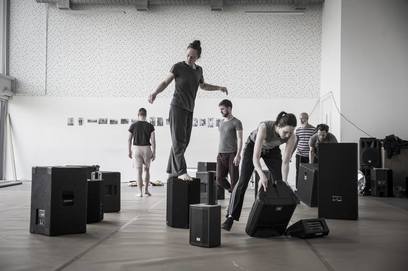
D: I think just to add to that as well, one of the early decisions we made was about the organic-ness of the context – why we’re on a beach, why we have the wind, the rain, the sand, the sea. And why, when you have those things, you don’t utterly embrace them. Or if you don’t embrace them, if you juxtaposition speakers or characters in costume, things that are incongruous to those natural elements, you are making a statement. And with the speakers, there was a theatricality - they had a meaning, they created a set, they created a sound sculpture, they worked on all sorts of levels, I think they gave the work a presentational form. Whereas for the film, our setting, our stage was this natural world. For example, we didn’t want to see other people in the frame. Though we did speak early on about whether you would see families, other people, because obviously the shore in TCP has a very particular meaning - literally this was the strand where Casement came ashore - and also metaphorically for the piece being about a statement of welcome to foreigners and about borders between people and countries. And other things we had to consider, like the life buoy hanging along the beach; there’s something quite beautiful about that red and yellow, it delights your heart, it says summertime. And initially, we thought that imagery was interesting, but when we walked and got deeper into the project you realize that that’s another language.
Picture
On a film set, it suddenly sets the story in a time. Everything means something. Because in a film you’re framing things so particularly that what you’re leaving out becomes important as well. So there was a lot of stripping back of elements from the stage show, including costumes, but also one particular unison sequence that I dropped on the day. It was something that was really mesmerizing on the stage, all the dancers in sync with each other, but I found it really surprising while I was in the middle of it that it was just really hard to make that work. It was the first sequence out of all the work we’d done that began to feel like dance on the beach - that we had taken it off the stage and put it on the beach, and that I think was very interesting. Because with everything else we kind of reinterpreted it and re-set it in some way.

F: Letting go of that sequence in unison was really easy for me on the day. I think that sequence is really important on the stage because it helps the eye rest for a bit with something that’s very clear and cohesive, so it’s a choreographic necessity in that environment, and I think that maybe in this environment, we didn’t need that. When you’re putting together a form, it tells you what it needs. And there’s also something interesting about the letting go of control. When we were making the film, everybody was worried about what the weather would be like, and of course it did have an impact. But there’s a willingness to embrace the thing that you can’t control and to work with it, and for me that’s very important - to work with the thing that you’ve planned but also to be able to welcome the thing that you haven’t planned. I guess that’s a set of values that is both part of the process, but also the content of the work. Otherwise we put ourselves in a situation where we don’t ever deal with anything difficult or unforeseen.

J: is there anything that didn’t work? Beyond technical difficulties. You obviously have a super connection, but was there any point of friction or something you couldn’t agree on? I’m thinking about the type of friction between, say, the writer and director. Like, someone like [Andrei] Tarkovsky would say ‘I have to rewrite everything into this new language. I cannot have the writer telling me that this one part is more valuable than this other part.’

D: Well, I’m not a writer I’m a director who works with choreographers, who work with writers. For me the process is absolutely about the marriage of people because I’m in it to learn. I take on projects where I don’t know what the end is. So I like to work with challenging DOPs or actors. On set, every day is like a bungee jump - the exciting bit is when the elasticity goes and you freefall. That’s what an actor brings. The stuff you can’t direct. The marriage of the writing and the lighting, or the right lenses... Obviously you go into it with a plan, but the more you do this job the more you realise it’s about sensibility.
​
F: For me I don’t feel friction because it’s trust. There’s no reason for me to make work if I know what it is already. If I go into a studio and I require the dancers to play out something that’s in my head, it’s of no interest to me. I’m there to learn. So collaborating with people that know things that I don’t know results in something more than I could make myself or imagine myself – it’s that element of wonderful surprise. I know from working with Dearbhla that by getting out of the way, by communicating as well as I can at the early stages what’s important to me in the work, what the heart of it is, maybe the values or the energy that’s driving it, because I trust Dearbhla hears and feels that, then I can get out of the way of her doing her job. And the result feels absolutely like it’s mine but something I could never achieve on my own because it’s made through her and is absolutely hers as well. So there’s something about surrender of control but with a lot of communication and trust that makes that happen.
 

I'm Roger Casement will air on RTÉ One Television at 11:10pm on the 17th of January and will be available to watch on the RTÉ Player following broadcast.

More on The Casement Project here
.

​Image on beach: Michael Kelly  
​Image in studio: Ste Murray.

This article first appeared in DRAFF Issue #4 in September 2016. 
  • HOME
  • ABOUT
  • IN PRINT
  • ON THE ROAD
  • ON FILM
  • OFFCUTS
  • CONVERSATIONS
  • PODCASTS
  • DONATE
  • CONTACT