DRAFF
  • HOME
  • ABOUT
  • IN PRINT
  • ON THE ROAD
  • ON FILM
  • OFFCUTS
  • CONVERSATIONS
  • PODCASTS
  • DONATE
  • CONTACT

Philip connaughton
+
Maria Nilsson Waller

​​in conversation

This month, Irish choreographer Philip Connaughton and Swedish choreographer Maria Nilsson Waller will have the Irish premiere of their most recent pieces, as part of Dublin Dance Festival 2017. Both choreographers are based in Dublin and both pieces connect to outer space (though Philip immediately disputes this in the conversation that follows). DRAFF brought these artists together to discuss the ideas and research that feed their work; their conversation ricocheted from outer space, to myth making, to nomads, to embodying chairs and glaciers, to the magic of imagination in performance.

Philip: …I don’t think of Extraterrestrial Events as being about outer space. It’s about UFO sighting reports that were made to the French police, and this department, GEIPAN, that’s part of the national centre for space studies, takes them and categorises them into ‘identified’ and ‘not identified’ sightings. I was more interested in the identified cases, because I’m interested in playing with truth, what’s real and what’s not real. I’m sure it’s the same for you, this experience of people thinking your show is about one particular topic that was maybe just a starting point for you… you get into so many different things when developing and researching. Sometimes people say to me about the show ‘Oh, it’s about aliens’, and I’m surprised. I saw merry.go.round when it was a work in progress at DDF [Dublin Dance Festival] in 2016 and I hadn’t read anything about it beforehand, but I did get a sense of something transcendental, a sense of something celestial or planetary.

Maria: That’s cool… somebody else was talking to me about it and saying they thought it was very scientific…

P: How important is that to you, that somebody takes it like that or sees it in that way?
​
M: I don’t know if it’s important to me. But it’s nice when things are clear – that this person somehow saw the pool of elements that I sponged off when making the show. I think it’s a small victory. If you’re making work and you have clear references, it’s great when they come across.

Picture
/1
P: It’s funny isn’t it, that whole idea of clarity coming across when you’ve filtered the work through so many ideas. That’s something I’m very aware of – that the piece is jam packed and how ok am I with that? Something I like is jam packing it and then giving the audience the option to focus on one point or take it all in at the same time. I think that’s something I noticed in your work too – there’s a lot of detail.

M: Yeah, there’s a lot. There’s a lot of material, a lot of references… but there’s a couple of core themes that are underneath, pushing things along… I guess this is true for you too?
​
P: Oh yeah, and some of them are beyond my control, which is interesting. I think that this idea of a sense of connection to a whole and the opposite of that, isolation, or individuality versus a collective sense, is something that is really, really important to me in the work and is something I always deal with.  And it’s funny, I think that’s what art is really; art stems from a need to find a sense of balance or a sense of completeness, it’s a side effect of feeling detached from a time when we were more connected to everything else. 
Picture
/2
M: Yeah yeah yeah, absolutely. When we were showing merry.go.round in Sweden in February, one of the groups we invited in was from something like what is called Direct Provision here, teenagers from this group. Most of them had no English or Swedish. And there was one guy who came up to me afterwards and asked me what the show was all about and I said ‘I don’t know, what do you think?’ I asked him what he saw, what he thought. And he said, ‘It’s just… everyone has to help out. We have to be together’. I think my piece is all about that journey in a way, individual people trying to connect, maybe in the romantic sense, but then somehow the resolution in the end is that we become a collective – that even two people is not enough. That guy who saw the show, he totally got it. In a sentence.

P: I don’t see it as being so resolvable I think. I think the separation is inevitable and I seem to be fundamentally interested in it… There’s something in all this about the idea of categorisation as a need to… as part of our progress and part of the way we deal with the environment we’re in. As part of our evolutionary history, the more complex our environment became, the more we’ve needed to categorise as a means of saving energy. It’s more efficient to talk about glasses in general, or the idea of a glass, than Philip’s glass and Maria’s glass. The problem with this increased categorisation is it turns on itself and we start to feel this need to categorise things, and if something is ‘in-between’ it kind of becomes this horrific problem for people and they get very frightened by it…
​
M: Yeah yeah yeah…

P: And I think that’s related to breakdowns in communication often.


M: I suppose that’s also related to minority social groups, because they’re hard to categorise, hard to nail down… socially, it’s very tricky be outcast, to be in-between, to be moving, nomadic, not set in one place. You’re uncategorisable. I was thinking about this idea of myths and contemporary urban myths… the void that comes about when a worldview or a system that explains things, like religion or science, when these things start to crumble there is this void, and maybe the romantic myth has filled that space. All these stories that we feed ourselves to make ourselves feel calm and not have to question so many things. But then it’s quite interesting how a lot of people would reject a lot of religious myths but that need for myth pops up in stories about aliens or Santa Claus… because there’s something comforting for people in having something to believe, you know.
P: I think that goes back to the idea of categorisation again, it becomes another category. If you look at what was happening from the 1940s onwards, which is when UFOs and science fiction and all of that started to appear, post WW2, it’s very interesting, because we basically shifted the paranormal, the ghosts and goblins and banshees, we took all of those stories and put them into UFOs and flying saucers and abductions, when before we might have been talking about fairy folk. So you’re absolutely right… it’s fascinating I suppose because in a way, even through it’s still categorising, it becomes much murkier territory and there’s a lot of space for imagination and interpretation and psychology… which is really beautiful. And probably because of that some very primordial thoughts, fears, desires surface. Things that could have been forgotten for a long time…

M: I’m thinking of a film, I forget the name, but it features two young boys, teenagers, and one of them believes in UFOs, but it turns out he was sexually abused as a child and he’s transformed the event into this UFO memory - a murky psychological twist to make sense of something that is very hard to make sense of as a five-year old boy.

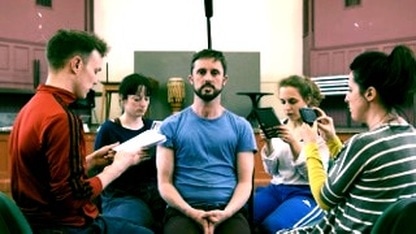
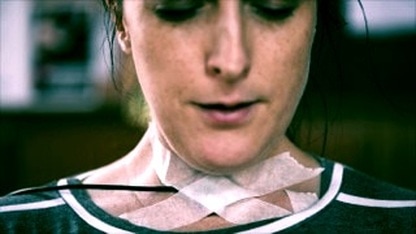
P: I think that’s what I’m doing with Extraterrestrial Events. The opera singer, Kim, who’s reliving all these case studies as personal experiences… I guess it’s about denial. It’s easier to focus on a fantasy as opposed to looking at the real problem which is right in front of you…

M: I think, to go back to this idea of myths and how they’re useful or not, we’re the generation that needs to be responsible and find out what works. We don’t have the same references as our parents, and we know those references, those stories, didn’t necessarily work anyway. We’re going to have to be responsible for the environment too – we’re the adults here […] Do you think there is a danger of people reading the theme of separation in your piece as being related to you being, for example, a gay man in Irish society?

P: No, no, no, my sense of separation or isolation from everything else is way beyond just gay or Catholic or Irish or anything like that. It’s much more about general perception. For example, you see a chair, you know what it is to make a chair, but you’ll never know what it is to be a chair. I didn’t say that, that’s Descartes.

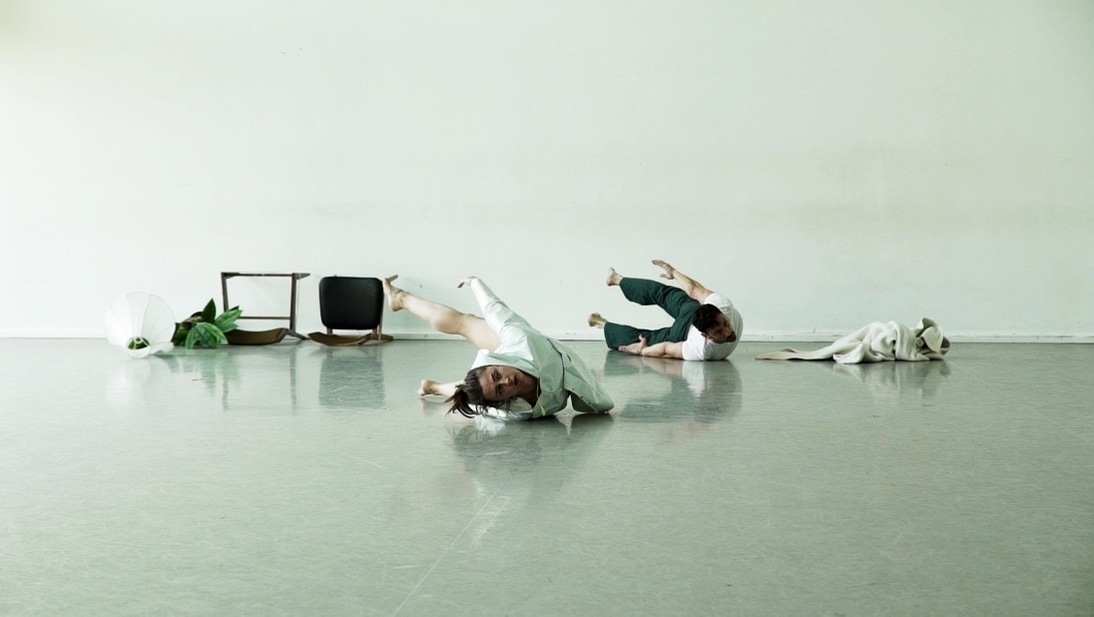
M: Unless you just embody the chair and dance it… I say it’s a chair and then you will see it, the audience will see it.

Picture
/3
P: It’s true, there’s an element of that.
​
M: That kind of clarity in imagination, that’s what I feed my work with all the time. I tell myself ‘I am a glacier’ and then people see glaciers. I don’t know how it works – it’s magic, it’s crazy.
​

P: I think that’s very beautiful though – and I think that’s relating again to the sense of the collective and the sense of the entirety of something, you have these essences… i'ts something that comes from categorisation. Categories give you a global sense of what things are. And from that global sense you can get an essence of something. So you know, by imagining a glacier you can maybe tap in to…

Picture
/4
​M: It’s so weird that it works, to be able to get that essence and to imagine it. You really have to be there in your own mind when you perform it and that’s the thing about performance being somehow a spiritual practice or soulful - if you really are fully there, it will happen and the essence will come across… but how does it work? I have this feeling that there is a big break about to happen, a shift in understanding, like when flat earth became round or we went into space, the big shifts in our view of the world. I think there is another big shift about to happen and I think it has to do with consciousness, as a species, as people, somehow connecting to the earth or to each other. I was reading these letters between two scientists, a theoretical physicist and a guy who studies consciousness. And there seemed to be a lot of questions around whether the universe is conscious. I think that the very human quality of playing together and sharing an invisible world that you create in your imagination… there is something real in that that is huge. Maybe we’re tapping in to some essence.

P: When I was working on Extraterrestrial Events, I was thinking of Jung, who wrote a lot on the paranormal, and he worked with this whole idea of collective consciousness. So he was saying that if these paranormal events are real, that’s the universe trying to tell you something, but if they’re imagined that’s your subconscious trying to tell you something. Either way, the fact that you’re thinking it or seeing it, something is trying to tell you something, so there is a sense of connection in that. It makes me think… I don’t particularly like participation from an audience in the physical sense, as an audience member myself. But I like to believe there’s a mental activity which is necessary, something you don’t get in TV, but which you do get in theatre, dance, live performance. It’s a necessary responsibility of the audience to try to connect with you, to try to work out what you’re doing, and that’s when it works, when those things come together. 


merry.go.round by Maria Nilsson Waller runs at the Samuel Beckett from the 23rd - 24th May. Philip Connaughton's Extraterrestrial Events runs at the Samuel Beckett Theatre from the 27th - 28th May. More at dublindancefestival.ie. 

Headline image: merry.go.round [Klaas Boelen]
​Images 1 + 2: Extraterrestrial Events in rehearsal [Luca Truffarelli]
Images 3 + 4: merry.go.round in the studio [Jose Miguel Jimenez]

Posted: 4th May 2017
  • HOME
  • ABOUT
  • IN PRINT
  • ON THE ROAD
  • ON FILM
  • OFFCUTS
  • CONVERSATIONS
  • PODCASTS
  • DONATE
  • CONTACT