DRAFF
  • HOME
  • ABOUT
  • IN PRINT
  • ON THE ROAD
  • ON FILM
  • OFFCUTS
  • CONVERSATIONS
  • PODCASTS
  • DONATE
  • CONTACT

THEO CLINKARD 
+
ELEANOR SIKORSKI
in conversation


CHOREOGRAPHER THEO CLINKARD SPEAKS TO ARTIST ELEANOR SIKORSKI ABOUT HOW TO DEAL WITH PROXIMITY IN DANCE AND HOW TO CREATE SPACE FOR THE DANCERS' REAL SELVES IN A PERFORMANCE, AHEAD OF THE OPENING OF HIS LATEST WORK THIS BRIGHT FIELD. THIS CONVERSATION TOOK PLACE AHEAD OF THE SHOW'S PREMIER IN BRIGHTON IN MAY 2017. 

Ellie: Theo and Ellie… date the…

Theo: 17th of May, 2017, Islington.

E:
So tell me Theo, your thoughts behind making something for an audience that is specifically bigger than you had before.


​T:
Well the plans to potentially make this work [This Bright Field] should we get funding, started about four years ago through dance4. And the invite was specifically to look at dance on a larger scale and how it might be done differently, read differently, designed differently. And knowing that commission was coming up, I made Of Land and Tongue, my last company work, for an audience of about sixty. So I did a very proximate, intimate show with reduced audience, and fell in love with all the detail and texture and tone that’s readable at a proximate distance. Once I’d made that work I realised how important that was to me and could I somehow, with this larger scale piece, somehow deal with… I dunno, I don’t like the word intimacy. I think it has lots of other connotations other than proximity. For me, in this sense, it’s just that you’re near. I was reading, going on a bit of a tangent here, but I was reading Juhani Pallasmaa’s The Eyes of the Skin, a really instrumental book for me, by a Finnish architect who talks about how we experience spaces through our whole selves and it seems quite obvious, but he’s kind of commenting on how in Western culture, a lot of what we experience is attending to the ocular, the visual sense, and he’s making a case for the fact that our whole beings are affected by the spaces we inhabit and how touch is historically low down on the scale of the senses, it’s lesser than. And he also articulates the haptic experience that you have through looking. So if I look at a piece of cold metal, let’s say, I’m having a touch trigger, even though I’m not touching it. So I think something about the proximity with the piece, because I’ve invited the dancers to be dealing with touch, and they’re often working in duet form, that the audience’s experience might be through their whole body, not just looking. Or in combination.

< 
our whole beings are affected by the spaces we inhabit
​>

So I proposed with this work to start with the audience on stage. We have about 100 audience on stage, around the perimeter of the space. So they come in waves of 100 at a time. And the second half of the piece ends in a more conventional way, with the audience seated… I often have a difficulty with the ‘about-ness’ of pieces. So for this one I was thinking about: what is already happening? Someone’s doing something, someone’s watching. So what is the act of watching, what is the act of doing, what is the agency in the performer’s experience, and what is it to have a seated second half where you have a same or a similar viewpoint, and to explore and play with what those different ways of looking and ways of doing do to our experience of being in the theatre.

​E:
Did you feel like you had to steer yourself back on to the stage a bit after falling in love with this more proximate state?
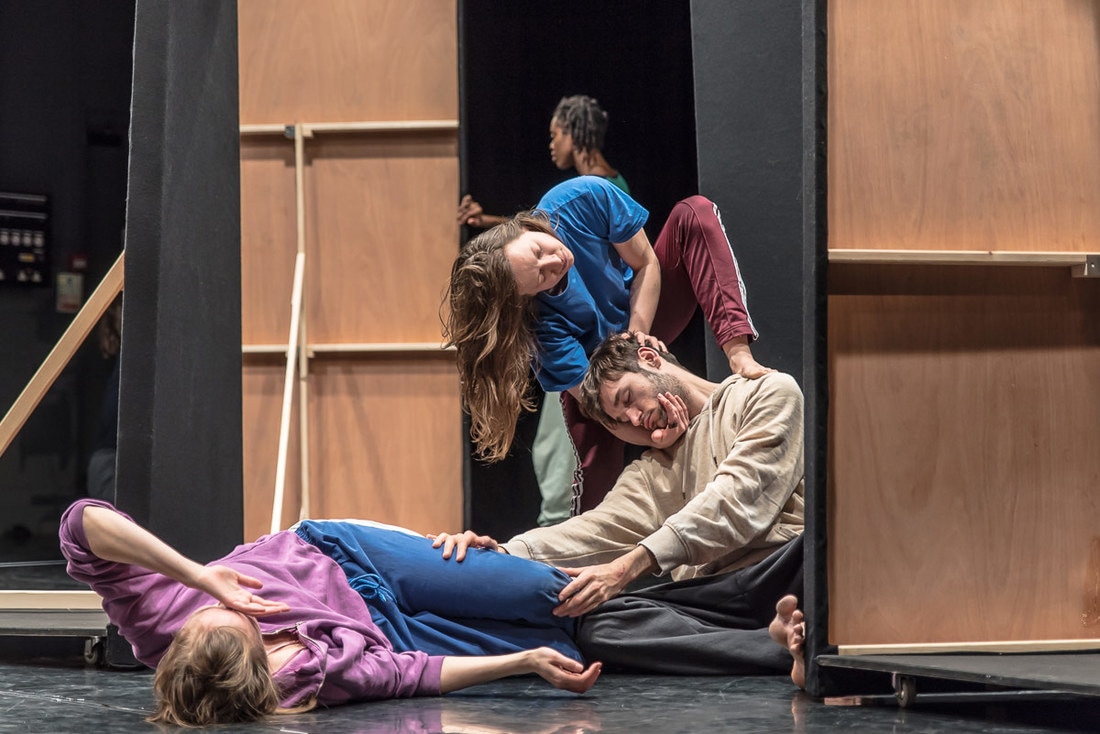
Picture
/1
T: Yeah, with the previous show we’d toured to a gym hall, a fruit market, a converted cinema, so we did lots of different spaces. Entering a space, your looking is affected by how you hold yourself differently in different spaces and what is it to witness dance outside conventional theatre settings, so to go back into a theatre with This Bright Field felt like a big *clunk*. I wanted to set up a situation where you’re not just in your default mode where you’re entering the space through the usual avenues as an audience … what if I look at that stage from 30 metres away after having just been on it, a foot away from the performer. It’s about trying to understand the group through the lens of an individual, so could that first part of the show, on stage, introduce me to the performers, a bit like when you meet them after a show and you realise what they sound like, how tall they are… could that happen first, so we’re invested in a different way.​

E: When you said this to me when you first talked about the piece with me, that made a lot of sense. And of course, I did get to know the dancers.

T: Because you came in as a support, outside eye, dramaturg…

E: Exactly. So by the time I got to watch the piece, I was watching it as though it were a show with people I knew in it. So I’m curious … did you get any feedback about people who had that straight experience of being on the stage and then watching the people from afar?

T: We had about thirty people filling out feedback forms after our preview … I think there were two people who said it didn’t necessarily affect them, but then there were lots of people who said they felt way more connected to the performers and that held out.

<
​It's about trying to understand the group through the lens of an individual >

E: Also, it must change depending on whether you’re used to being on a stage on not. I remember going to see the Boris Charmatz piece on Sadler’s Wells stage last year, and something about Sadler’s Wells being so massive and so… important for a dancer… I had a really particular excitement, almost like a school girl’s excitement. Even though I’m really used to going on stage. So if someone isn’t used to being on stage, there’s an element of backstage excitement.
​

T: Yeah, and we’re bringing the audience in through the stage door onto the stage, so having that whole journey or unfamiliar entrance point or framing of the work that might invite a different way of looking. I don’t make work that is wow-y physically, gymnastic, spectacle, circus…

E: I could argue with that.

T: Really?

E: Maybe not the last few words.

T: Yeah … well, I do design works, there’s a big visual element, but I’m not asking the body to do the extraordinary so…

E:
Just a few jetés… [laughs]


​T:
[laughs] Yeah… but the idea of what else can be a special experience or where else can there be spectacle, if it’s not the body… So that first idea of coming on stage and seeing the installation being an interesting invitation for audiences and different to other performances I’ve seen.


E: I think what's quite interesting is that everything in the piece has the potential to be big or spectacular or whatever, because at some point the bodies do explode all of a sudden, and at some point the costumes are suddenly shocking, and at some point the lights are really dramatic, so I’m just thinking this now as I’m talking, but in the same way that you’re maybe asking people to come back to zero a little bit in terms of seeing the performers, coming on to the stage and meeting them a bit more personally…

T: Yeah, maybe reflecting on a similarity you might have with them.

E: … so when they go into the auditorium it’s not their default. There’s also this feeling that anything could come to the front, like sound, light, costume, which is maybe also disturbing that default expectation.

T: I think there’s something about a touch-driven first part between the performers which you might reflect upon or have a physical sense of as you watch, and in the second part I’m really doing the opposite so the very first section of the second part is very much dealing with the visual, it’s attending to the eye on purpose. I remember a very particular point in my career at which I understood that the body isn’t having to do all the work. With Chalk, a duet I made, we were looking at chalk cliffs, the paradox that chalk could crumble in your hands but could also have this epic scale, how could scale be looked at through the whole piece. So the musician playing his trombone, crossing the theatre, going out on to the street at the end of the performance, playing with the scale of the sound itself, or what the lights are doing, or reproducing myself 1cm tall out of white tack… how themes can be playing through all of the elements, the light, the structure, all of those can have meaning. It takes the pressure off the dancer having to evoke everything.

E: Yeah, but then what’s interesting is translation between bodies, living bodies or object bodies, how do you translate a sensation or an image from one to the other? How does the sound evoke what the dance has previously been evoking? Do you have any thoughts about surprise at all in your work? When I think of your work, there’s this thing of… things pop out, maybe it is to do with the piece jumping between all the elements that it’s comprised of. But also maybe there’s an attempt to jolt people into reconsidering what’s happening. Is that how you think or is it just accidental?
T: I think there might have been something about setting up for surprise, but I still feel like I’m first and foremost dealing with movement, and not necessarily movement as a carrier of expressive emotional intent, it’s not like Tanztheatre, but I do think all the elements of text and song and props and light and sound and costume are all available to me and I just like to play with them and see what they might evoke or reference for people. I think it’s not radical experimentation… I look at the work I made and I can’t really see any signature. And I know there are themes like empathy that interest me no matter what I’m making, because I’m on some level always thinking about what I want to put in the world, not in any grand way but to keep connecting to why we put something on the planet, why it exists. But the element of surprise … I think … I know that I’m mischievous as a person, but I also really like formality … I can’t take myself too seriously for too long … it’s not necessarily humour I’m dealing with but I quite like charm and I quite like poetry and maths and science as well.

<
I know there are themes like empathy that interest me no matter what I’m making
​>

E: [laughs] Right – you’re an all-rounder. But there is something in that isn’t there? Just thinking about how the costume changes in the piece, it’s so dramatic! It doesn’t necessarily feel like that in every moment, but it’s quite marked.

T: But if I’m making a piece that’s looking at the act of looking, then the body being transformed by nudity, everyday wear, whatever that is, old-school leotards, and then crazy over the top costume, that keeps affecting our reading of the group and if the piece is about reading then that can be the currency or a featured element, because though the piece doesn’t have narrative as such, it does have some kind of narrative sense, I have to accept that.

E: Well you can’t escape that can you.

T: No, I think we have a disposition to find narrative everywhere.

E: But also, you put any two things next to each other and it’s arguably a narrative and it’s not about projecting onto that, it’s just that there is a shift from one thing to another and that’s a step and a step has to take a direction, and a direction is immediately a timeline, and a timeline is immediately a narrative … but then, does that frustrate you that you can’t escape narrative, in its abstract sense? Would you rather be able to float more in each moment, no strings attached?
​

T: I don’t know if this is really an answer but what I am interested in is dealing with formal principles, space, time, relationship, structure, counterpoint … but there’s not a formality to the performers themselves. I’m seeing if it’s possible to articulate something that is quite graphic and sculptural in space but with freedom inside that to be living and breathing it as if it’s improvised, even if it’s not, inviting the performers to consider their approach to doing that each day as different so they’re not making themselves anonymous in it. I keep looking for a way in which I can be dealing with presence and tone and availability through using the senses and perception, but that I might not necessarily need it to be a fully improvised and experimental movement language... It’s not really an answer to your question at all.

 < 
I think we have a disposition to find narrative everywhere
>

E: Are you talking about somehow juxtaposing a state with content in order to dislocate it?
​

T: I think I’m trying to get at something that is making the performers as themselves, as those people that day, available to me as I watch. Rather than dealing with character for example – like developing characters for dance theatre narrative. So I feel like the movement is humanised somehow, but I don’t necessarily need to read narrative.

E: Is it for example, if you’re performing, is it Theo dancing or is it Theo playing a role? It’s like the question of ‘do I go to dance school, or do I go to acting school?’, and it’s like, well, do you want to be yourself on stage or do you want to be other people? This question seems to be present in almost every process I’m in as a performer, at some point, and there’s no clear line between the two states. If I’m performing my solo work, it’s like a weird version of myself. And you can’t necessarily control that either.

T:  Well, I think what I’m proposing is that the you-ness can be available and perceivable by an audience even if the material is learned from someone else. I keep thinking about repertory recently, if you made something you considered as repertory, the margin of how you enter into it is noticeable as something that can be conscious, rather than it being that you are the material because you are improvising, generating in real time… so you think ‘there’s the thing I did yesterday, my arms go here, I’m going to do the same thing, but today I had a big lunch, so…', to be different every day, can I open up to that, let the performers open up to that in the act of performing.
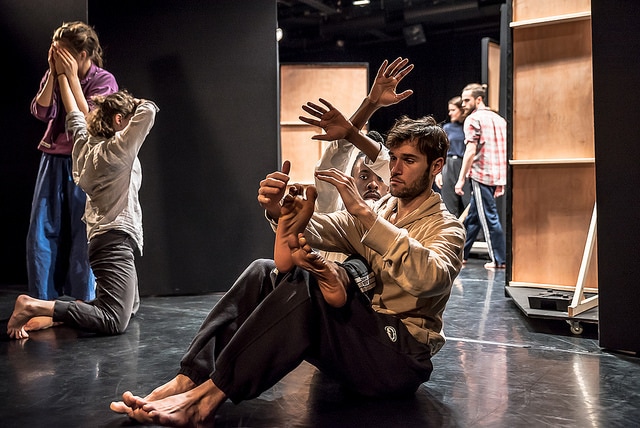
Picture
/2
E: What’s the effect of that on an audience do you think?
​

T: Well it’s my hope that people aren’t looking at versions of me onstage, but they’re connecting with different performers. The more diverse a group of performers I can get the more potential there is for someone to identify with someone in that group. So the more performer-audience relationships I can develop by leaving space for them to be versions of themselves, the more connection or investment audiences might have with the work through the lens of whatever that individual is.  

E: Is that an ethical thing do you think, in terms of your approach to taking up that space?

T: I think as a dancer I became very able and trained to take on different movement styles, I was wearing other people’s clothes and adaptable, and when I came to start making my own work I didn’t know who the hell I was and what the hell I thought and I’d never been in processes that allowed me to collaborate to the degree I do now with performers. I’m just interested in people, more than myself. I think that dance may not attract many choreographers who genuinely are, there’s such a potential to be dealing with power and abusing power and getting people to do what you want … I remember teaching a class and I was telling the students to do this and that, and I suddenly got really scared of the power I wielded in that moment. It was like Simon Says. I freaked out a bit.​
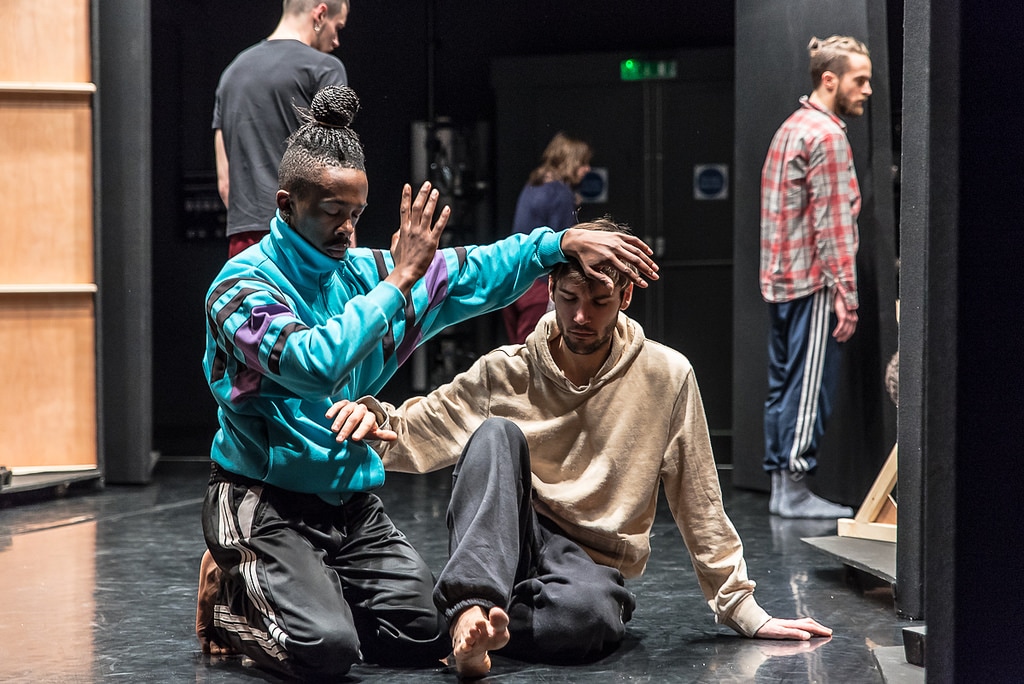
Picture
/3
E: A kind of positive twist on that is that in theory it should be that both of those approaches are possible. Maybe your priority as a choreographer is that you have an idea and you need people to execute it, I think that’s legit. It’s hard to do that without abusing that service the dancer is providing. In a way it’s a different concept, or a different artistic priority, being interested in the dancers. It’s a collaboration or engagement that’s very different. And I think ideally those two things can exist, but the reality is without that engagement with the performer as a person it very quickly becomes about power and the blocking of the dancer.

T: I think that sometimes I have a good idea but often I’m entering into the room, inviting people to participate in something to start with and then what comes up in the room is something that really triggers me and then I’m working instinctively with what’s in the room.

E: Also, if you’re inviting dancers in then that’s a stepping stone to inviting audience in and if you never do that exposing, that kind of communication with other people, other than yourself, then how do you expect an audience to even really relate to your work?
​

T: I was saying to a young choreographer I’m mentoring today, in that very first moment of meeting a new group, for about 30 minutes you get to be an audience member yourself, so if you can set up something that allows you to see them …

E:
… before you put your thing on them …

T: …there’s a lovely moment of ‘I’m witnessing everything as an audience member’.

This Bright Field by Theo Clinkard premieres tonight as part of the Brighton Festival. 
​
Headline image: Chris Nash
​Images /1, /2, /3: This Bright Field in rehearsal, Stephen Wright

Posted: 24 May 2017
  • HOME
  • ABOUT
  • IN PRINT
  • ON THE ROAD
  • ON FILM
  • OFFCUTS
  • CONVERSATIONS
  • PODCASTS
  • DONATE
  • CONTACT